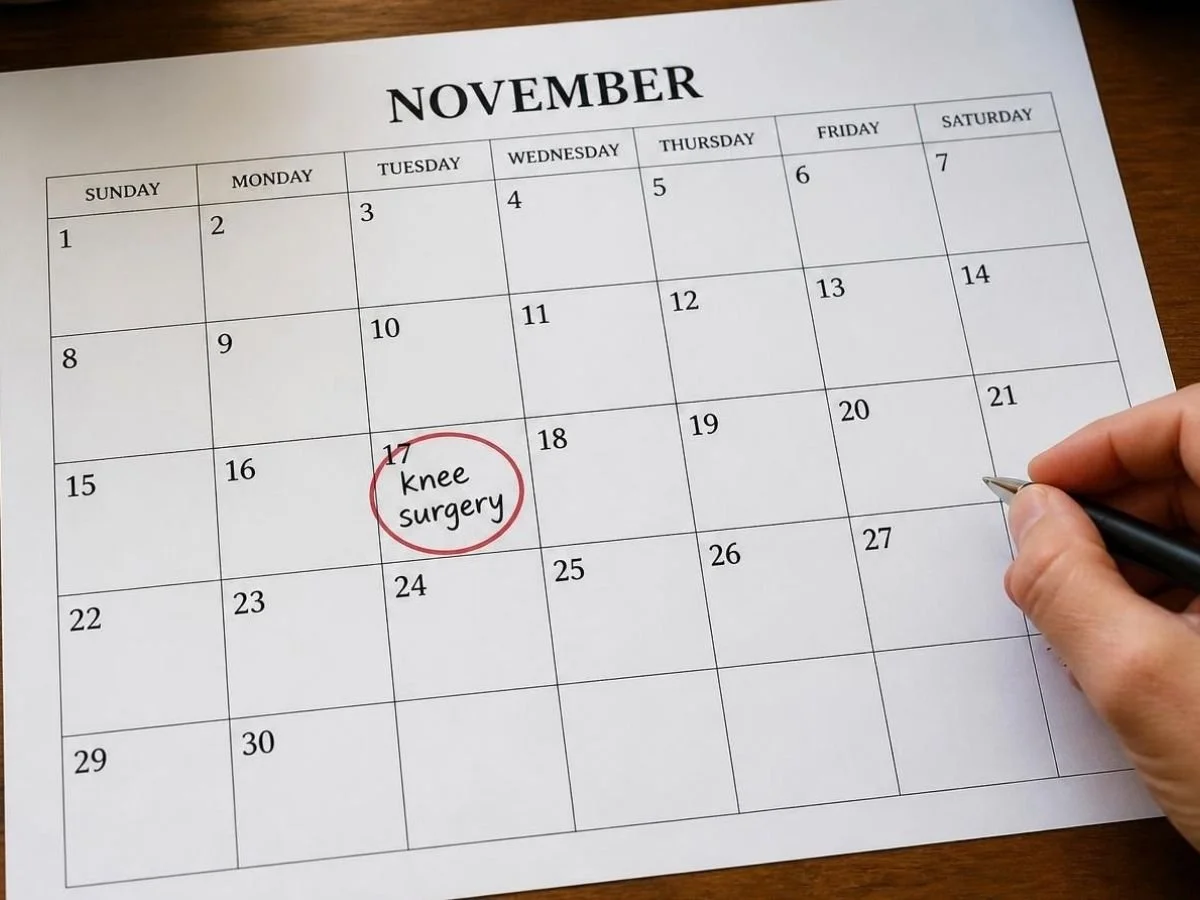
Here’s your 6 week surgery prep timeline
If you have a surgery date sometime in December, or you're about to pick one, this post is for you.
You're in good company. Every fall, I talk with people working toward the same thing: getting a knee replacement, hip replacement or shoulder surgery done before the new year begins.
What most people don't have yet is a plan for the weeks in front of that date. Your surgical team will walk you through the final week and the day of surgery, including which medications and supplements to stop, often with a thick packet of instructions. The four, five or six weeks between today and your date are yours to shape, and that's where a plan makes a real difference.
Here it is: a week-by-week pre-surgery checklist for a December date, built around the six pillars I use with every pre-surgical client. Bookmark it and share it with the person who'll be driving you home.
The catch with a December surgery date
Getting surgery done before your deductible resets on January 1st, or lining up your healing time with holiday time off, is a smart call. A date picked this late in the year, though, leaves four to six weeks of runway, sometimes less.
A shorter runway doesn't mean the prep matters less. It means every week matters more.
Your six-week pre-surgery checklist
Each stage builds on the one before it, and each maps back to the six pillars: nutrition, gut health, sleep, stress, movement and community. Along the way, you'll also build two practical toolkits: your pain management plan and your household readiness checklist.
New to the pillars? Start here: How to Recover From Orthopedic Surgery, A Functional Medicine Approach
One note before you start: your surgical team's instructions always come first. If anything here doesn't match what they've told you, follow them and bring the question to your next appointment.

6 weeks out: lay the foundation
Pillars: nutrition, gut health, sleep, stress
This is the stage for the big rocks, the things that need time to move.
Take an honest look at how you eat and drink. Is there protein at most meals? Are you drinking enough water most days? Many people head into orthopedic surgery quietly under-fueled, especially when pain has made shopping and cooking harder. You're not overhauling your diet. You're building a steadier baseline.
Check in on your gut. How regular are you right now? Anesthesia and pain medications commonly slow digestion after surgery, so steady fiber, fluids and regular meals now give you a better starting point.
Look at your sleep. When do you go to bed, what wakes you up, how rested do you feel? Pain and poor sleep feed each other, and that loop is much easier to work on now than after surgery.
Write down what you can do today. How far can you walk? How do stairs feel? Can you stand up from a low chair or the toilet without your hands? This isn't a test. It's your starting point, and it shows you what's worth protecting.
Start a simple calming practice. A few minutes of slow breathing each day. Six weeks of practice means it will feel familiar when you need it most.
Open the packet. If your surgeon gave you one, skim it now and write down your questions.
4 weeks out: build your reserves
Pillars: movement, community
Think of these weeks as deposits into a health savings account. Everything you put in now is something you get to draw on while you heal.
Move, if you've been cleared. The more strength and range of motion you carry into surgery, the more you have to work with during rehabilitation. Ask your surgeon or PT what's right for you. Not everyone should exercise before surgery, which is exactly why this pillar is personalized.
Start the support conversations now. This is the step people wait too long to address. The person driving you home, the person staying the first few nights, the friend who checks on you on day four when the meal trains stop: ask them now, while their calendars are still open. In December, everyone wants the same days off, so be specific about what you need and when.
Handle work. If your employer requires time off paperwork, start it this week. Forms that need your surgeon's signature can take time.
Ask about a temporary parking placard. If you may not be able to walk far after surgery, ask your surgeon's office whether a temporary disability parking placard makes sense for you. The application through your state's DMV needs a signature from your provider and can take a while to process, so start it now so it's in hand when you need it.
2 weeks out: logistics and rehearsal
Pillars: nutrition, gut health, plus your pain management plan and household readiness checklist
Walk through your home as the person you'll be two days after surgery. Throw rugs, cords, stairs, the bathroom, where your everyday things live. Move what you use daily to between waist and shoulder height. In December, watch for holiday decorations that crowd walkways or add extension cords to the floor, and line up someone to salt and shovel your front steps and the path to the car.
Decide where you'll sleep and sit. If stairs will be hard, plan for that now, not on the drive home. Set up your pain strategy. Medication decisions belong to your surgical team. Prep the rest of the toolkit: get ice packs or an ice machine, practice any gentle movements you have been given and keep going with the breathing exercises you started a month ago. Prepare and learn the tools now, not on day two when you're sore and foggy.
Fill the freezer. Cook double for a week, or line up easy, protein-rich meals you'll actually want to eat.
Get your medication questions answered. Your team will give you a list of medications and supplements to stop before surgery. If you don't have it yet, ask for it now, since some may need to stop more than a week ahead. While you're at it, ask what they recommend for keeping your digestion moving after surgery. Don't guess, and don't change anything on your own.
Order equipment. Shower chair, raised toilet seat, reacher, ice machine, grab bars, or whatever your team recommends. Holiday shipping can be slow.
1 week out: protect what you’ve built
Pillars: sleep, community, stress
Protect your sleep. This is not the week for late holiday parties or a 5am wrap-up of every work project.
Finalize the ride and the first 72 hours. Who drives you there and home? Who stays the first nights? Write it down and share it with everyone involved.
Confirm your pre-op instructions. Arrival time, eating and drinking rules, which medications to take or hold, what to bring. Call the office if anything is unclear.
Nothing new or heroic. No new supplements, no new workouts, no deep-cleaning, no hosting. The goal this week is steady.
48 hours out: calm
Pillar: stress, plus your household readiness checklist
Set up your spot. Where are you going to recover? The couch? Your bed? A recliner? Wherever you choose, within arm's reach should be your phone and a long charging cord, a water bottle, your medications and schedule, the remote, your glasses, tissues, easy snacks, a notebook and your surgeon's office number. Keep it all together in a basket so it can move with you if you change locations.
Pack your bag: if you're staying overnight or might be. Include a phone charger and easy to put on clothes and shoes for the trip home.
Then rest. Use your breathing. Let the people who offered to help, help.
If you have less than 4 weeks
Maybe you're reading this with three weeks to go. Or ten days. You have not missed the boat.
A shorter runway just means we stop trying to do everything and focus on what matters most.
With less than a month, these three should be your top priority:
Your people. Lock in your ride home and your help for the first 72 hours. That's one or two phone calls, and it takes a huge weight off.
Your recovery location and your path. Set up the spot you'll heal in and clear the route to the bathroom. That's an afternoon, not a project.
Your calming and pain tools. Even a week of practicing slow breathing means it won't feel new on day two. Get your ice packs or ice machine ready now too, so they're in the freezer or set up before you come home.
Then, if you have room: get your medication questions answered, start your parking placard application if you'll need one and put a few easy meals in the freezer. Everything else, do what you can and let the rest go.
Remember, preparing for surgery doesn't stop at the hospital doors. Everything you build now becomes a reserve you draw on in the weeks after, and that's where a lot of the work continues.
Turn this timeline into your plan
Everything above is a general timeline.
Your timeline depends on your surgery, your health, your home, your job, your people and how many weeks you actually have. That's what my 90-minute pre-surgical health coaching session is for.
It's one focused conversation, in person in Potomac, MD or virtually from wherever you are. Virtual is often easier when getting out the door is hard, and on video you can walk me through your home: the stairs, the bathroom, the spot you'll heal in. We look at the full picture through a functional medicine lens: all six pillars, your home setup and anything quietly getting in the way of healing. Bring your surgeon's packet if you have one, and we'll sort out what matters most for you.
I'm not replacing your surgeon's instructions. I'm just here to help you follow them.